
LiFePO4 vs. NMC: The 10-Year Decision You’re Making in 10 Seconds
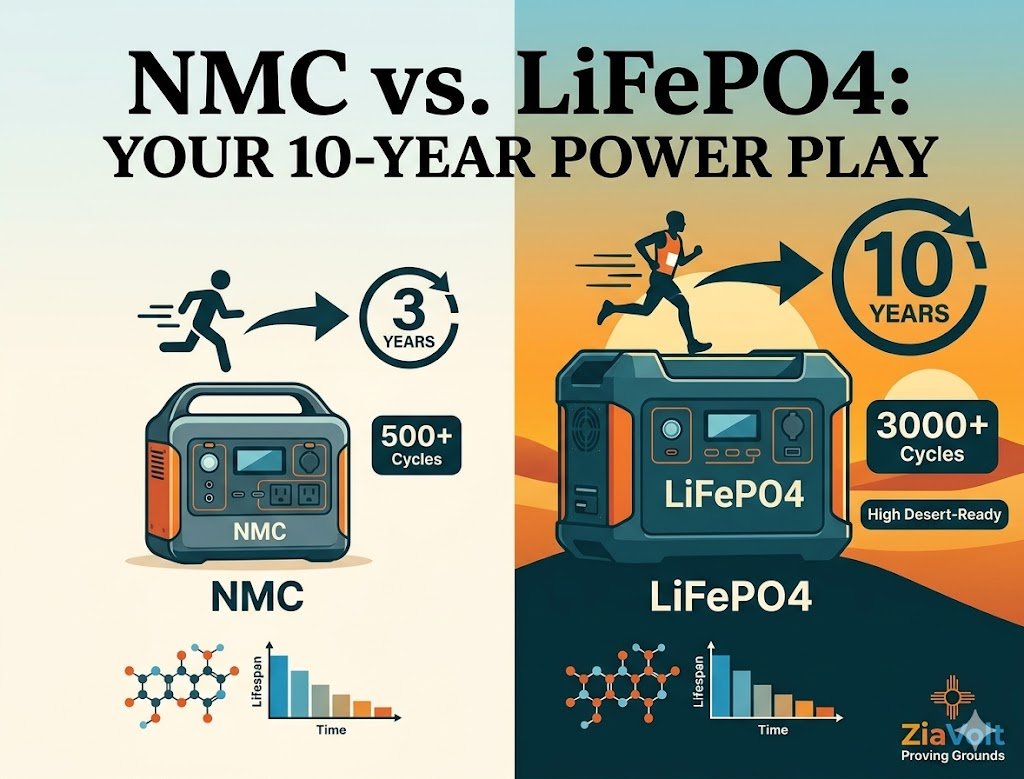
NMC vs. LiFePO4:
The Battery Chemistry Decision That Will Define Your Off-Grid Life
Two power stations. Same label. Completely different lifespan. The $300 difference at checkout is nothing compared to what you'll pay over time.
You're standing in your garage — or maybe sitting in your van at a trailhead somewhere outside of Albuquerque — staring at two portable power stations. Same plastic shell. Same handle. Same glowing LCD screen reading "1000Wh." One is $700. The other is $1,100.
You have ten seconds.
If you reach for the cheaper one without understanding what's actually inside it, you may just be making the most expensive mistake of your off-grid life. Not expensive because you spent $700. Expensive because you'll spend it again in three years. And possibly again after that.
The difference between these two machines isn't the brand name, the number of USB ports, or even the watt-hours on the label. It lives at the chemical level — in the battery cells themselves. One unit runs on NMC (Nickel Manganese Cobalt). The other runs on LiFePO4 (Lithium Iron Phosphate). To anyone just getting into off-grid power, that's alphabet soup. To someone who's spent real time running systems in the heat and dust away from the grid, it's the difference between a tool that lasts three years and one that lasts a decade.
Here's the unfiltered breakdown.
NMC: The Sprinter
Nickel Manganese Cobalt chemistry has been around for years. It's the same technology powering your smartphone, your laptop, your wireless earbuds. There's a reason it became the dominant chemistry in consumer electronics: it is exceptionally energy-dense. NMC packs a serious amount of power into a small, light package.
For certain use cases, that matters a great deal. If you're a weekend warrior who camps twice a year, or a backpacker who counts every ounce before a long trail, NMC's compact, lightweight profile is genuinely appealing. It will charge your phone, run a fan overnight, and keep your lights on. For light, infrequent use, it gets the job done.
But here's what the spec sheet doesn't tell you up front: sprinters burn out.
The critical number with any battery is its cycle life — meaning how many times you can fully charge and discharge it before it loses significant capacity. For NMC, that number sits between 500 and 1,500 cycles depending on cell quality and usage patterns (older or budget cells run 500-800; premium modern NMC can reach up to 1,500). After those cycles, the battery will have dropped to roughly 80% of its original capacity. That degradation doesn't stop there; it keeps going.
Do the math for a daily user. One cycle per day, 365 days a year — with a budget NMC cell (500 cycles), you're hitting the wall in under 18 months. Even with premium NMC (1,500 cycles), you're shopping for a replacement before year five. Your "1000Wh" station is delivering less and less power each year, and the decline accelerates.
There's another issue that doesn't get talked about enough: heat. NMC chemistry is thermally sensitive. It runs hotter during charging and discharging, and it has a lower thermal threshold before it starts to stress. In extreme failure scenarios — rare, but real — NMC is susceptible to thermal runaway, a chain reaction that can lead to fire. This isn't meant to scare you; millions of NMC devices operate safely every day. But context matters. A laptop left on a desk is different from a power station stored in a van baking under a July sun in the high desert.
LiFePO4: The Marathon Runner
Lithium Iron Phosphate chemistry — LFP, or LiFePO4 — has been disrupting the portable power market for good reason. Brands like EcoFlow, Bluetti, and Anker have largely shifted their serious, workhorse-grade units to this chemistry, and the reason is straightforward: it lasts.
LiFePO4 doesn't win on weight or compactness. It is slightly heavier and bulkier than a comparable NMC unit. If you are obsessing over grams, that's a real consideration. But if you're building a system meant to run daily for years — in a van, a cabin, a mobile office, a home backup setup — the weight trade-off is barely a footnote.
The cycle life of a quality LiFePO4 power station runs between 3,000 and 3,500 cycles before dropping to 80% capacity. At one cycle per day, that's nearly ten years of daily use before you see a meaningful performance decline. Even the most aggressive daily user will get nearly a decade from a quality LFP unit.
The safety profile is also genuinely different. LiFePO4 is chemically stable at higher temperatures. It does not carry the same thermal runaway risk as NMC. It contains no cobalt — a mineral tied to serious ethical concerns in its global supply chain — and it is considered non-toxic. For anyone sleeping three feet from their power station in a van or RV, that combination of thermal stability and non-toxicity isn't a marketing point. It's a real and meaningful advantage.
✓ NMC Strengths
- Lighter weight per Wh
- More compact form factor
- Lower upfront cost
- Higher energy density
- Well-suited for occasional use
✗ NMC Weaknesses
- 500-1,500 cycle lifespan (varies by quality)
- Heat sensitive — thermal runaway risk
- Contains cobalt
- Degrades faster in daily use
- Higher long-term cost per cycle
✓ LiFePO4 Strengths
- 3,000-3,500 cycle lifespan
- Thermally stable — no runaway risk
- No cobalt (cleaner supply chain)
- Non-toxic chemistry
- Lower long-term cost per cycle
- Ideal for daily use
✗ LiFePO4 Weaknesses
- Heavier per Wh
- Bulkier form factor
- Higher upfront price
- Overkill for emergency-only use
The Number That Actually Matters: Cost Per Cycle
Most people evaluate a power station purchase the way they'd evaluate any consumer purchase — they look at the sticker price, wince or don't wince, and decide. That's the wrong metric entirely.
The number that matters is cost per cycle: what you actually pay for each day of usable power over the life of the unit.
Run the math honestly:
• Budget NMC station at $700 ÷ 500 cycles = $1.40 per day of use
• Premium NMC station at $900 ÷ 1,500 cycles = $0.60 per day of use
• LiFePO4 station at $1,100 ÷ 3,000 cycles = $0.37 per day of use
The unit that costs $300-$400 more at the register ends up costing you nearly one-fourth per day across its life compared to a budget NMC unit. The "expensive" battery is dramatically cheaper. You're not paying a premium — you're prepaying for a decade of independence at a steep discount.
This math gets even starker when you factor in the inconvenience and real-world cost of replacing an NMC unit every two to five years: the purchase price, the time spent researching and ordering, the waste of a dead battery headed to a landfill, and the potential gaps in your power setup during transition.
So Who Should Buy What?
NMC still has a legitimate use case, and it's worth being honest about that.
Choose NMC if: You are an emergency-only user — someone who keeps a power station in the hall closet for the occasional blackout, charges it a few times a year, and never comes close to cycling it heavily. The lighter weight and lower entry price of NMC make practical sense. You won't hit 500 cycles in a decade of backup use. The long cycle life of LiFePO4 would be overkill, and you'd be paying for durability you don't need.
Choose LiFePO4 if: You are a van lifer, full-time off-gridder, mobile professional running laptops and monitors and routers, family building medical-grade backup systems for CPAP machines or refrigerated medications, or anyone who will use this thing regularly. The heat tolerance alone makes it the right answer for anyone operating in hot climates. The cycle life makes it the right answer for anyone relying on their unit daily. The safety profile makes it the right answer for anyone sleeping near their system.
The bottom line: Two power stations. Same label. Completely different chemistry, completely different lifespan, completely different value proposition. NMC is a sprinter: fast out of the gate, light on its feet, and burned out before you're ready to replace it. LiFePO4 is a marathon runner: a little heavier, a little more expensive on day one, and still going strong when the NMC unit has been in a landfill for seven years. Don't buy for today's price. Buy for the next ten years of power. When you understand what's actually inside the machine, the decision isn't close.
EcoFlow Delta 2
The gold standard for daily-use LiFePO4. 3,000+ cycles means 8-10 years of daily use. Best-in-class value for full-time off-grid.
Shop EcoFlow Delta 2 →Jackery Explorer 1000
Excellent for emergency backup and occasional camping. Not designed for daily cycling. Best for light, infrequent use where weight matters.
Shop Jackery Explorer 1000 →